


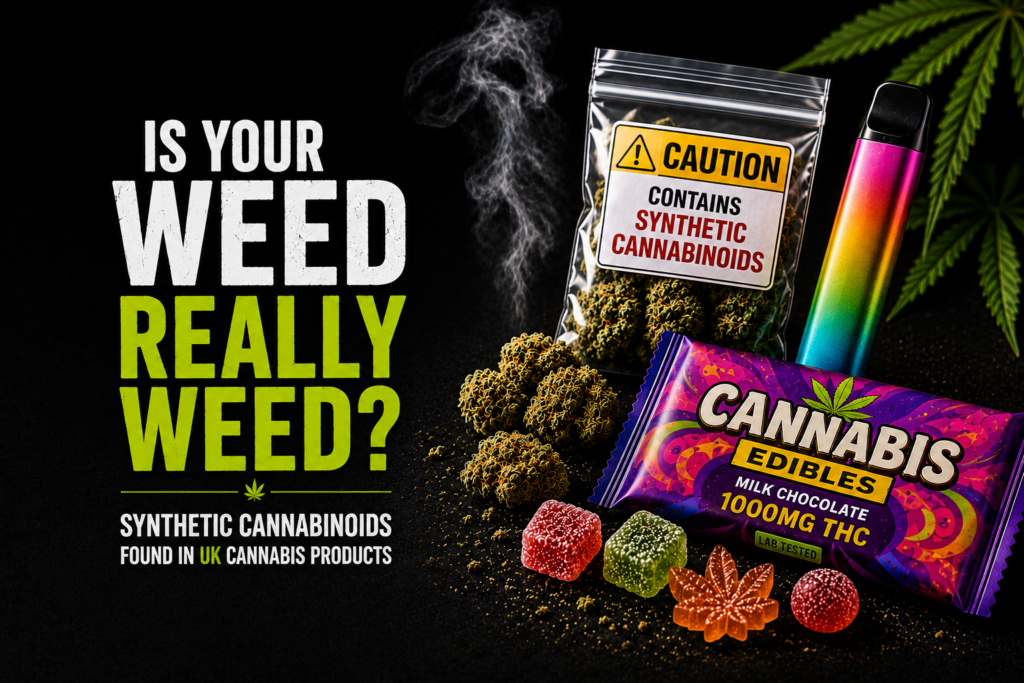
If you buy a THC vape on the illicit market, there is a growing possibility that the substance inside isn’t THC at all.
The latest figures from WEDINOS, the UK’s largest drug-testing programme, make uncomfortable reading.
Between April 2025 and March 2026, 43% of THC, CBD or cannabinoid vape products submitted to WEDINOS contained synthetic cannabinoid receptor agonists (SCRAs) — the group of drugs commonly associated with products such as Spice.
That doesn’t mean 43% of every cannabis vape being sold in the UK contains synthetics. WEDINOS relies on voluntarily submitted samples and isn’t a random survey of the cannabis market.
But it does confirm something important:
Synthetic cannabinoids are being sold to people who believe they are buying cannabis.
And it isn’t an entirely new problem.
Fake THC vapes are becoming difficult to ignore
The latest WEDINOS figure follows an already concerning result from the previous year.
Between April 2024 and March 2025, WEDINOS received 297 samples submitted as THC, CBD or cannabis vapes.
Of those, 117 — 39% — contained one or more synthetic cannabinoid receptor agonists instead, according to the WEDINOS 2024/25 findings.
For 2025/26, that figure has risen to 43%.
These aren’t random samples taken from every vape circulating in Britain, so they cannot tell us the overall percentage of contaminated products on the street.
What they can tell us is that substitution is happening repeatedly.
There is supporting UK evidence outside the annual figures too.
A study published in the journal Addiction analysed seven illicit disposable vapes sold as cannabis products in the UK.
Laboratory testing found the potent synthetic cannabinoid 5F-MDMB-PICA in every one of them, with no other pharmacologically active compounds detected.
The researchers also found that the vapes closely resembled regulated vaping products. There was nothing in their appearance, labelling or packaging that would have told the person using them that they contained a synthetic cannabinoid.
This isn’t just about dodgy vapes
Vapes are currently providing some of the clearest UK evidence, but synthetic cannabinoids being passed off as cannabis aren’t restricted to cartridges and disposable devices.
They have also been found in cannabis flower and resin.
Across Europe, drug-checking organisations have identified low-THC cannabis adulterated with potent synthetic cannabinoids and sold as cannabis.
European drug-checking research has documented hundreds of samples containing the potent synthetic cannabinoid MDMB-4en-PINACA, including herbal cannabis and resin.
Other research involving drug-checking services in Switzerland found synthetic cannabinoids in half of 94 cannabis samples analysed.
The European Union Drugs Agency (EUDA) continues to warn that products sold on the illicit market as cannabis may be adulterated with potent synthetic cannabinoids.
So the idea of so-called “sprayed weed” isn’t an internet myth.
There is laboratory evidence showing that it exists.
What we don’t have is evidence showing that large amounts of ordinary high-THC cannabis sold across the UK are routinely being sprayed with synthetic cannabinoids.
That’s an important distinction.
What else has been found in cannabis products?
Synthetic cannabinoids aren’t the only unexpected drugs that have turned up in products submitted as cannabis.
A 2025 analysis of WEDINOS data examined 1,635 cannabis and cannabis-derived products.
More than a third — 624 samples, or 38.17% — contained a psychoactive adulterant.
By far the most common were synthetic cannabinoid receptor agonists, detected in 435 samples — 26.61% of everything tested.
The researchers also identified much smaller numbers of other drugs, including cocaine, opiates and ketamine.
Nine of the 1,635 submitted samples — 0.55% — contained opiates.
That deserves some perspective.
Nine detections among 1,635 submitted products is very different from evidence that opioids are routinely being added to cannabis.
There is currently no good evidence that fentanyl, nitazenes or other extremely potent synthetic opioids are commonly being added to cannabis sold in the UK.
Claims about widespread “fentanyl-laced weed” should therefore be treated cautiously.
The evidence we actually have points much more strongly towards synthetic cannabinoids as the significant adulteration problem affecting products sold as cannabis.
What are synthetic cannabinoids?
The name causes some confusion.
Synthetic cannabinoids aren’t simply “synthetic THC”.
They are a large family of laboratory-made chemicals that interact with the body’s cannabinoid receptors, particularly CB1.
THC also acts at the CB1 receptor, but that doesn’t make the substances equivalent.
THC is a partial agonist at CB1. Many synthetic cannabinoid receptor agonists are full agonists and can interact much more strongly with the receptor.
The result can be effects substantially different from somebody’s normal experience with cannabis.
Synthetic cannabinoids have been associated with severe anxiety and agitation, confusion, hallucinations, psychosis, seizures and loss of consciousness.
Serious and sometimes fatal poisonings have also been associated with synthetic cannabinoids.
This is why describing everything that acts on a cannabinoid receptor as “cannabis” is misleading.
Cannabis and synthetic cannabinoid receptor agonists are not the same drug.
Why would anyone put synthetics on cannabis?
Money is one obvious explanation.
Low-THC cannabis or hemp can provide plant material that looks and smells like cannabis but produces little intoxication on its own.
Add a highly potent synthetic cannabinoid and that otherwise weak material can suddenly produce a powerful psychoactive effect.
The buyer may simply think they’ve bought unusually strong weed.
Synthetic cannabinoids can also be active at very small doses, meaning relatively small quantities can potentially produce large numbers of doses.
The same deception can be even easier with vapes.
A liquid can come inside convincing packaging and be sold as “THC”, while the consumer has practically no way of knowing what is actually dissolved inside it.
Unless somebody sends it for laboratory analysis, the substitution may never be discovered.
The dosing problem
There is another problem with applying potent synthetic cannabinoids to plant material: the substance may not be distributed evenly.
Drug-checking research into adulterated cannabis has found considerable variation in the concentrations of synthetic cannabinoids.
That matters when some of these compounds are active at very low doses.
One section of plant material could potentially contain considerably more of the substance than another.
With ordinary cannabis flower, cannabinoids such as THC and CBD are naturally produced by the plant’s glandular trichomes.
Strength can certainly vary between strains, plants and individual flowers, but that’s a different situation from applying an extremely potent laboratory-made cannabinoid to another plant material.
Adulteration adds another layer of unpredictability.
What about edibles?
Cannabis edibles are another increasingly complicated part of the market.
The EUDA’s latest assessment of new psychoactive substances warns about synthetic cannabinoids being mis-sold or used to adulterate cannabis products without the consumer’s knowledge.
Europe has also seen a rapid increase in semi-synthetic cannabinoids appearing in products including flavoured vapes, gummies and other edibles.
These shouldn’t all be lumped together.
Semi-synthetic cannabinoids such as HHC and related compounds are different from the potent SCRAs associated with Spice, such as 5F-MDMB-PICA and MDMB-4en-PINACA.
But their appearance illustrates the same basic problem with an unregulated product:
the label may not accurately tell you what’s inside.
A colourful wrapper saying “1000mg THC” doesn’t prove there’s actually 1000mg of THC inside it.
Can you tell if weed has been sprayed?
Not reliably.
Unusual appearance, smell, taste or effects might make somebody suspicious, but none provides proof.
The same problem is even worse with vapes and packaged edibles.
Packaging means very little on an illicit market.
A professionally printed box saying “THC 95%” isn’t a laboratory result.
Neither is a chocolate wrapper claiming “1000mg THC”.
It’s packaging.
Ultimately, chemical analysis is the only reliable way of establishing what these products actually contain.
The 43% figure needs some perspective
There is a temptation to turn the latest WEDINOS statistic into:
“Nearly half of UK THC vapes contain Spice.”
We shouldn’t.
That isn’t what the data proves.
People voluntarily send substances to WEDINOS for testing. Someone who has experienced an unexpected or unpleasant reaction has more reason to submit a product than somebody who used one and experienced exactly what they expected.
The samples therefore cannot be treated as representative of every THC vape circulating in the UK.
But dismissing the findings because of that limitation would be equally misleading.
WEDINOS found synthetic cannabinoid receptor agonists in 39% of submitted cannabinoid vape products in 2024/25.
The figure was 43% in 2025/26.
Independent UK laboratory research has found synthetic cannabinoids in disposable vapes sold as cannabis, while European drug-checking programmes have identified adulterated cannabis flower and resin.
The problem clearly exists.
What we don’t yet know is exactly how widespread it is across the overall illicit cannabis market.
Cannabis isn’t harmless. That isn’t the point.
None of this requires pretending cannabis is completely harmless.
THC can cause problems, particularly at high doses or in susceptible people. Cannabis can produce anxiety and paranoia, impair driving and lead to dependence in some users.
Those risks should be discussed honestly.
But there is a fundamental difference between choosing to consume cannabis and unknowingly consuming a completely different drug.
Someone buying cannabis intends to consume THC and probably has some idea of how cannabis normally affects them.
Replace that THC with a potent synthetic cannabinoid and that knowledge disappears.
The dose is unknown.
The drug may be unknown.
Its potency may be unknown.
And the person consuming it doesn’t even know that they’re taking something different.
That’s an entirely avoidable additional risk.
Medical cannabis versus the mystery vape
There is an obvious contrast with the UK’s legal medical cannabis market.
Most cannabis prescribed in the UK is supplied as an unlicensed medicine, but that doesn’t mean it is unregulated.
Cannabis-based products for medicinal use are supplied through a controlled pharmaceutical system. The MHRA has specific requirements governing the manufacture, import, distribution and supply of unlicensed medicines.
That’s very different from an anonymous THC vape bought through social media or cannabis flower handed over with no reliable information about where it came from or what it contains.
Medical cannabis isn’t immune from quality-control problems, and being prescribed doesn’t make cannabis risk-free.
But there is accountability.
There is a defined product and a legal supply chain behind what the patient receives.
On the illicit market, there is no equivalent guarantee.
For decades, prohibition has meant cannabis consumers often have little reliable information about potency or possible contaminants.
Synthetic cannabinoids add another possibility:
The cannabis you bought might not even produce its effects from cannabis.
Harm reduction: what can cannabis users actually do?
There is no simple home test that can reliably prove a vape or cannabis flower is free from synthetic cannabinoids.
Be particularly cautious with illicit “THC” disposable vapes and cartridges.
Branding, QR codes, colourful packaging and claimed THC percentages aren’t proof that the contents have been independently tested.
If a cannabis product produces effects dramatically different from what you normally experience — particularly sudden extreme intoxication, collapse, severe agitation, hallucinations or seizures — don’t simply assume you’ve found exceptionally strong weed.
Stop using the product.
WEDINOS provides an anonymous substance-testing service and publishes its results online.
Testing a suspicious product doesn’t make it safe, but laboratory analysis can establish what substances are actually present and contributes to the wider understanding of what’s circulating.
If someone becomes unconscious, has a seizure or becomes seriously unwell after using a suspected cannabis product, treat it as a medical emergency.
The uncomfortable reality
For years, warnings about synthetic cannabinoids focused largely on Spice products, prisons and vulnerable groups.
The market is more complicated than that now.
Synthetic cannabinoids are turning up in products presented as something much more familiar: THC vapes and cannabis products.
The latest WEDINOS data shows that 43% of submitted THC, CBD and cannabinoid vape products contained synthetic cannabinoid receptor agonists.
UK laboratory research has confirmed synthetic cannabinoids in disposable vapes sold as cannabis.
European drug-checking services have demonstrated that cannabis flower and resin can also be adulterated.
And wider WEDINOS analysis shows that other unexpected substances occasionally turn up too — although the evidence points overwhelmingly towards synthetic cannabinoids rather than opioids as the main adulteration concern.
That doesn’t mean your next bag of weed is probably sprayed.
The available evidence doesn’t justify telling people that it is.
But the risk is real.
And there’s an obvious principle underneath all of this:
If someone chooses cannabis, they should be able to know that what they’re consuming is actually cannabis.
Prohibition has never been particularly good at providing that guarantee.


