


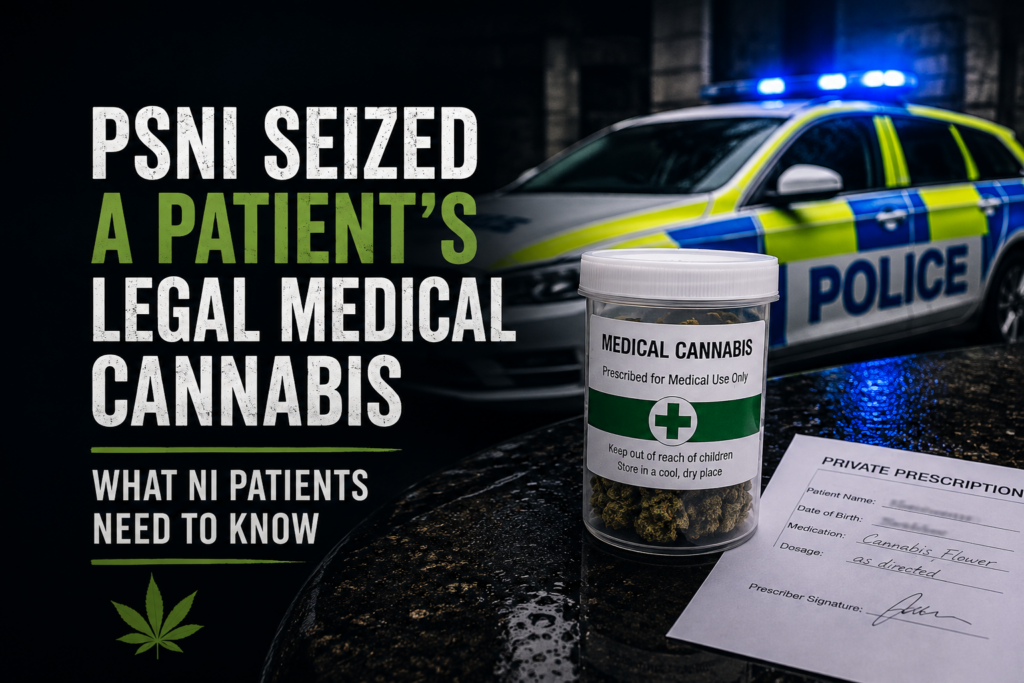
Medical cannabis has been legal on prescription in the UK since 2018.
Yet in 2024, a medical cannabis patient in Northern Ireland had their prescribed cannabis seized by the PSNI despite holding a valid prescription.
The Police Ombudsman has now found that the officer failed to follow PSNI guidance. Following the investigation — and a review of other similar complaints — the Ombudsman recommended further training and guidance for officers dealing with legally prescribed cannabis.
The PSNI medical cannabis case raises an important question for patients in Northern Ireland:
What should actually happen if the PSNI find cannabis on you and it’s legally prescribed?
In this article
- What happened in the PSNI case
- Medical cannabis law in Northern Ireland
- What patients should carry with them
- What to do if police question your prescription
- Medical cannabis flower and vaporisation
- Carrying and using medical cannabis in public
- Why the Ombudsman’s findings matter
What Happened?
The incident happened in 2024 after police stopped and searched a car.
Officers found a quantity of cannabis belonging to the complainant, who explained that it was medically prescribed and held a valid prescription.
The cannabis was seized anyway.
The officer later said there appeared to be discrepancies between dates on the prescription and the medical container.
However, the Police Ombudsman’s investigation found that the officer hadn’t explained those discrepancies to the patient and hadn’t made the enquiries required under PSNI guidance to obtain the correct prescription.
There were also problems with how the seized cannabis was handled, secured and recorded.
In June 2026, the Police Ombudsman announced that recommendations for the officer to be dealt with through performance procedures had been accepted by the PSNI’s Professional Standards Department.
More significantly for other patients, the Ombudsman’s Office reviewed similar complaints and made a policy recommendation for further PSNI training and guidance around legally prescribed cannabis.
That’s the bigger issue.
Medical cannabis has been legally prescribed for years, yet there are clearly still gaps in understanding about it.
Yes, Medical Cannabis Is Legal in Northern Ireland
This shouldn’t need saying in 2026, but there’s still plenty of confusion around it.
Cannabis remains a Class B controlled drug in the UK.
However, cannabis-based products for medicinal use were rescheduled in 2018, creating a legal route for qualifying products to be prescribed.
That applies in Northern Ireland too.
NI Direct specifically provides guidance for people prescribed medicinal cannabis and explains how patients can prove that they have a legitimate prescription.
So prescribed cannabis isn’t simply illegal cannabis with a doctor’s note attached.
When supplied and possessed lawfully, it’s a prescribed controlled medicine.
What Should You Carry With Your Medical Cannabis?
You shouldn’t have to carry a folder of paperwork every time you leave the house.
But because cannabis remains a controlled drug outside the medical framework, making your prescription easy to verify can save a lot of hassle.
NI Direct advises patients to:
- Keep the medicine in its original packaging with the dispensing label.
- Keep a copy of the prescription.
- Keep a letter from the prescribing doctor if they have one.
- Be prepared to show identification matching the details on the dispensing label, prescription or doctor’s letter.
The doctor’s letter, where available, should contain your details and the prescribing doctor’s name and contact information.
If you’re looking into becoming a patient, read our guide to getting a medical cannabis prescription in Northern Ireland.
Quick Checklist for Patients
Carrying prescribed cannabis?
Keep it in the original pharmacy packaging, leave the dispensing label attached, have evidence of your prescription accessible and carry matching identification.
In other words, don’t empty your prescribed flower into an unlabelled bag and leave everything else at home if you can avoid it.
Keep it in the pharmacy packaging.
What If a PSNI Officer Doesn’t Believe Your Prescription?
Don’t turn it into a roadside argument.
Explain that the cannabis is prescribed medication and show the dispensing label, prescription and identification you have available.
If an officer has doubts about whether the prescription is genuine or current, that’s where the recent Ombudsman case becomes particularly important.
The Ombudsman’s investigation found that the officer hadn’t made the enquiries required under PSNI guidance to obtain the correct prescription.
The answer to uncertainty shouldn’t simply be to assume that the cannabis is illegal.
There are ways for police to investigate whether someone is lawfully entitled to possess a controlled medicine.
Can Medical Cannabis Really Be Flower?
Yes.
This probably causes more confusion than anything else.
Prescription cannabis doesn’t necessarily come as tablets, capsules or a bottle of oil.
Medical cannabis can be supplied as dried cannabis flower.
And yes, it looks like cannabis.
It smells like cannabis.
Because it is cannabis.
The appearance or smell of cannabis flower doesn’t tell a police officer whether possession is lawful.
The important question is whether the person is legally entitled to possess that particular medicine.
Can You Smoke Prescribed Cannabis?
No.
This is an important distinction that sometimes gets lost in discussions about legal medical cannabis.
Having a prescription doesn’t make smoking cannabis lawful.
When cannabis-based products for medicinal use were rescheduled in 2018, the regulations continued to prohibit their administration by smoking.
Prescribed cannabis flower is instead generally supplied for vaporisation in accordance with the patient’s prescribing instructions.
So there’s a difference between:
possessing prescribed cannabis flower
and
smoking that cannabis in a joint.
A prescription doesn’t make every method of consuming cannabis legal.
What About Carrying and Using Medical Cannabis in Public?
Being outside your home doesn’t suddenly make your prescription invalid.
Patients obviously need to travel, work, visit family and generally live normal lives while taking medication.
The sensible approach is to keep your cannabis properly labelled and use it according to your prescription.
There is an obvious practical problem, though.
To somebody unfamiliar with medical cannabis, a patient using cannabis flower in a vaporiser may look very similar to somebody using cannabis recreationally.
That’s exactly why police understanding matters.
Patients can’t reasonably be expected to make prescribed cannabis stop looking or smelling like cannabis.
Why This PSNI Case Matters
One officer getting something wrong would be one thing.
What’s more significant is what happened afterwards.
The Police Ombudsman’s Office reviewed other similar complaints and recommended further training and guidance for PSNI officers dealing with legally prescribed cannabis.
That suggests the issue isn’t necessarily confined to one encounter.
Medical cannabis has been legally available on prescription since November 2018.
By now, police officers should be equipped to recognise that somebody possessing cannabis isn’t automatically committing an offence simply because the medicine happens to be cannabis flower.
Police still have an obvious job to do enforcing laws around unlawful possession, cultivation and supply.
But properly enforcing those laws also means recognising when possession is lawful.
Patients Have Responsibilities Too
There are responsibilities on both sides.
Patients can make encounters much easier by keeping their medication in the original pharmacy packaging, leaving the dispensing label attached and keeping evidence of their prescription accessible.
Turning up with loose cannabis in an unmarked container and expecting an officer immediately to know it’s prescribed isn’t going to help matters.
But patients who have taken reasonable steps to demonstrate that their cannabis is legally prescribed should also expect police to understand the medical cannabis framework and make appropriate checks.
That’s not asking for special treatment.
It’s asking for the law to be applied correctly.
Nearly Eight Years Later, We Should Be Past This
The UK’s medical cannabis laws changed on 1 November 2018.
We’re approaching eight years since that happened.
Yet some patients still worry that they’ll have their prescription confiscated simply because the officer they encounter doesn’t understand medical cannabis.
The recent Police Ombudsman investigation shows that isn’t an entirely imaginary concern.
The positive part is that something came from it.
The PSNI accepted the Ombudsman’s recommendations, and further training and guidance have been recommended following a review of similar complaints.
Hopefully that means fewer patients will find themselves having to explain the medical cannabis laws to the very people responsible for enforcing them.
Because whether somebody personally approves of medical cannabis or not is irrelevant.
Prescribed medical cannabis is legal in Northern Ireland.
After nearly eight years, that really shouldn’t still be controversial.
This article is intended as general information about prescribed medical cannabis in Northern Ireland and shouldn’t be treated as individual legal advice.


