


Saving Energy in Indoor Cannabis Cultivation
Originally written by Joseph R. Pietri, author of The King of Nepal
First published 2011 · Updated for archive reference 2026
Editor’s note
This article reflects one grower’s approach and experience from an earlier era of indoor cannabis cultivation. Lighting technology, genetics, and growing methods have evolved since it was written. The views expressed are those of the author, based on practical experience at the time. Results may vary depending on strain, environment, and equipment.
How to reduce the cost of growing cannabis using the 12-1 lighting schedule
The biggest innovator in cannabis cultivation in my generation is Reinhard Delp. Not only did he invent and hold the patent for ice water extraction, he had been building flower forcers since the early 1990s. He was among the first to introduce feminised seeds to Europe in the late 1990s, using natural processes rather than chemical methods.
No grower has been copied more and matched less. One of the moments that impressed me most was seeing two plants grown side by side: one completely covered in powdery mildew, the other perfectly clean. At the time, Delp was working on mildew- and mould-resistant genetics.
In the late 1990s, Reinhard brought back what is known as the Gas Lantern Routine, a lighting method found in horticultural textbooks, and applied it to cannabis cultivation.
Why 18–6 isn’t natural for cannabis
Cannabis only needs around 13 hours of light to remain in vegetative growth. The commonly used 18–6 lighting schedule places unnecessary stress on plants, as cannabis simply does not receive that amount of uninterrupted daylight outdoors.
Cannabis is an outdoor plant. Even equatorial varieties do not experience 18 hours of sun per day, and most modern strains contain some level of indica genetics, which evolved in regions with shorter daylight cycles. No cannabis growing in Afghanistan receives 18 hours of sunlight during vegetative growth.
Indoor cultivation should aim to replicate natural conditions, not exaggerate them.
The 12-1 (Gas Lantern) lighting schedule explained
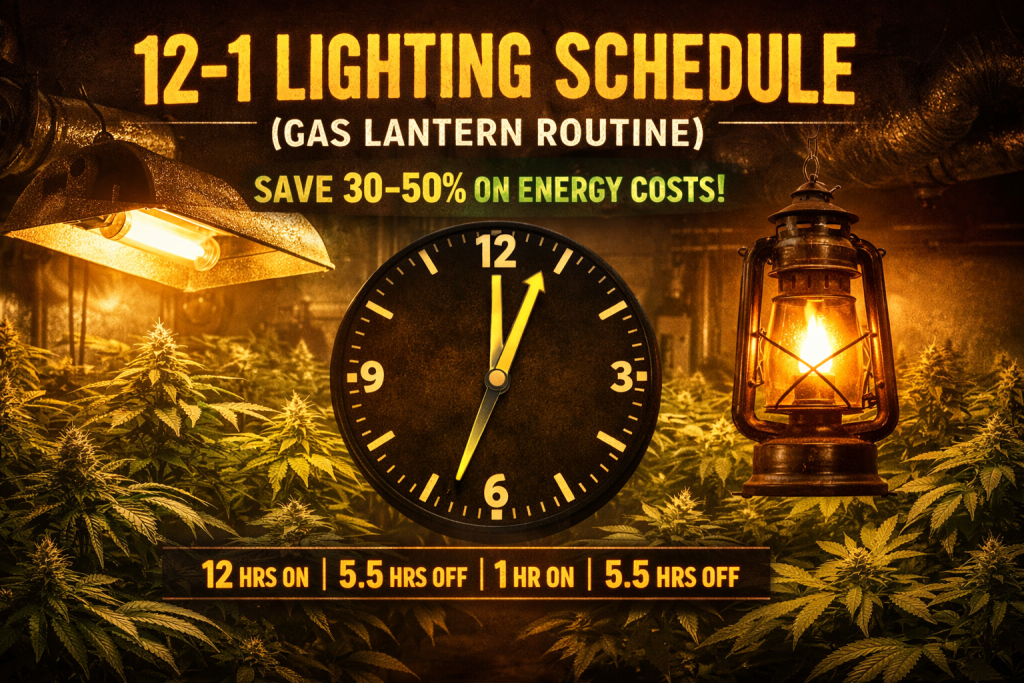
The 12-1 lighting schedule works as follows:
- 12 hours lights on
- 5.5 hours lights off
- 1 hour lights on
- 5.5 hours lights off
This cycle repeats every 24 hours.
That single hour of light in the middle of the dark period is enough to reset the plant’s internal clock and keep it in a vegetative state. The plant perceives the night as interrupted, preventing flowering.
The immediate benefit is a saving of five hours of electricity per day, alongside reduced wear on bulbs and equipment.
Plant response and growth
Plants respond quickly to the increased rest period. Growth becomes more relaxed and balanced rather than forced.
Within the first two weeks, plants often show significant increases in size and structure. Growth under the 12-1 schedule produces bushier plants with more bud sites, even before topping or training.
When combined with topping and plant training, the number of potential flowering sites can exceed what is achieved under an 18–6 schedule using the same techniques. Plants grow stronger and more efficiently, with less overall energy input.
Flowering: copying the sun, not the timer
Rather than switching abruptly to a 12–12 schedule for flowering, this approach follows the natural reduction of daylight that occurs outdoors as seasons change.
Suggested progression:
- Weeks 1–2: 11 hours on / 13 hours off
- Weeks 3–4: 10.5 on / 13.5 off
- Weeks 5–6: 10 on / 14 off
- Weeks 7–8: 9.5 on / 14.5 off
- Final weeks: 9 on / 15 off
Outdoors, cannabis flowers as days gradually shorten. Mimicking this process indoors aims to encourage fuller development and more natural flowering behaviour.
A more natural indoor approach
Cannabis evolved outdoors, under the sun — not under artificial timers running extended light cycles. The widespread use of rigid 18–6 and 12–12 schedules prioritises convenience over biological rhythm.
The 12-1 lighting schedule offers an alternative approach: one that seeks to work with the plant’s natural responses while significantly reducing energy consumption — in some cases by as much as 30–50%.
By copying how cannabis grows in nature, growers can reduce costs, extend equipment life, and cultivate plants in a way that aligns more closely with their natural development.


